 Skip to content

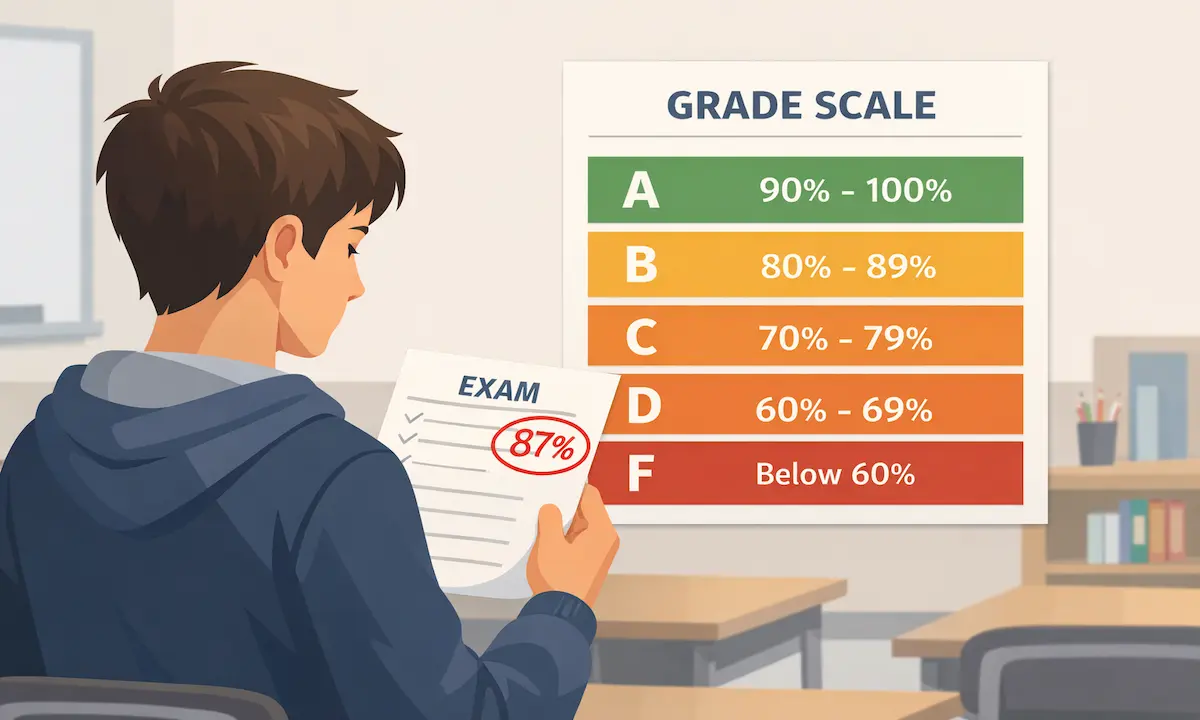
Converting a percentage to a letter grade is simple once you know the grading scale. On a common U.S. grading scale, 90–100% is an A, 80–89% is a B, 70–79% is a C, 60–69% is a D, and below 60% is an F.
Use the chart below to find your letter grade, or enter your score into our Percentage to Letter Grade Calculator for a quick result.
Important: Grading scales can vary by school, college, course, and teacher. Always check your school’s grading policy for the exact cutoff.
Quick Percentage to Letter Grade Chart
| Percentage | Letter Grade |
|---|---|
| 90–100% | A |
| 80–89% | B |
| 70–79% | C |
| 60–69% | D |
| Below 60% | F |
- Percentage grades show raw exam scores
- Letter grades summarize performance
- Most schools use 90–100% as an A
- Grading rules can vary by school
- Always check rounding and passing rules
Percentage to Letter Grade Calculator
Enter your score and total points to calculate your percentage and letter grade.
For example, if you scored 45 out of 50:
45 ÷ 50 × 100 = 90%
On the common grading scale above, 90% is an A.
Our grade calculator can help you check your percentage and match it to a letter grade without doing the calculation by hand.
| Percentage | Letter Grade | Typical GPA |
|---|---|---|
| 97–100% | A+ | 4.0 |
| 93–96% | A | 4.0 |
| 90–92% | A- | 3.7 |
| 87–89% | B+ | 3.3 |
| 83–86% | B | 3.0 |
| 80–82% | B- | 2.7 |
| 77–79% | C+ | 2.3 |
| 73–76% | C | 2.0 |
| 70–72% | C- | 1.7 |
| 67–69% | D+ | 1.3 |
| 63–66% | D | 1.0 |
| 60–62% | D- | 0.7 |
| Below 60% | F | 0.0 |
These ranges are an example of a commonly used U.S. grading scale. Schools and colleges may use different cutoffs and GPA values.
What Is a Percentage Grade
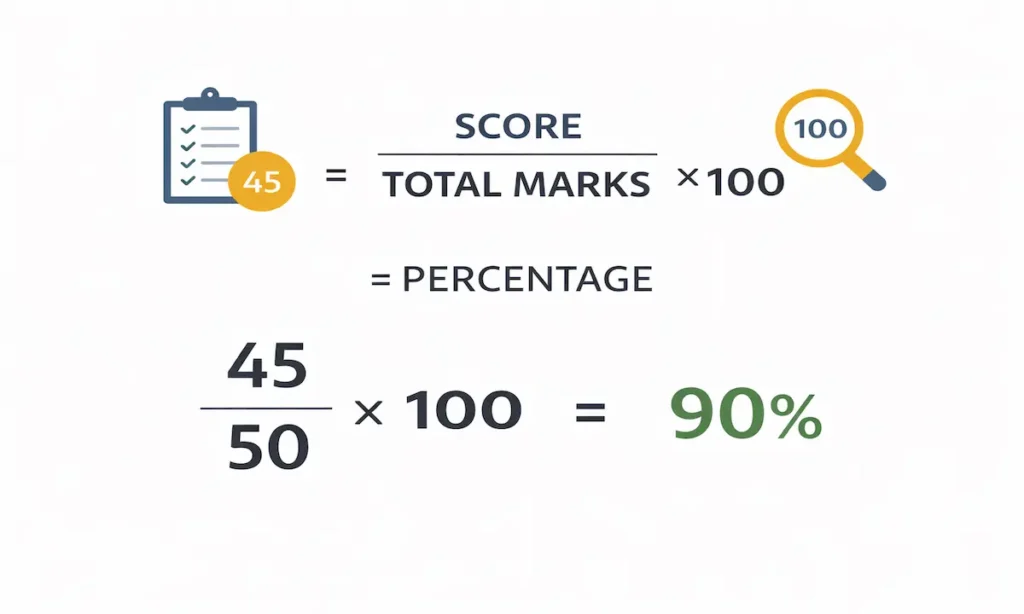
A percentage grade shows how much you scored out of the total marks.
This helps students check results quickly.
It also helps parents confirm report card grades.
Here is the formula:
Score ÷ Total Marks × 100 = Percentage
Example:
You scored 45 out of 50.
45 ÷ 50 × 100 = 90%
Your percentage grade is 90%.
- Confirm your total marks
- Check if rounding is allowed
- Know your school grading scale
- Confirm passing grade rules
How Do You Convert a Score to a Percentage?
To calculate a percentage grade, divide the points you earned by the total possible points and multiply by 100.
Formula:
Percentage = (Points Earned ÷ Total Points) × 100
Example
You score 42 out of 50.
42 ÷ 50 × 100 = 84%
Using the common grading scale, 84% is a B.
You can then use the percentage-to-letter-grade chart to find the matching grade.
Typical Percentage to Letter Grade Conversion Scale
Most schools use a similar grading scale.
Still, exact cutoffs may change by school.
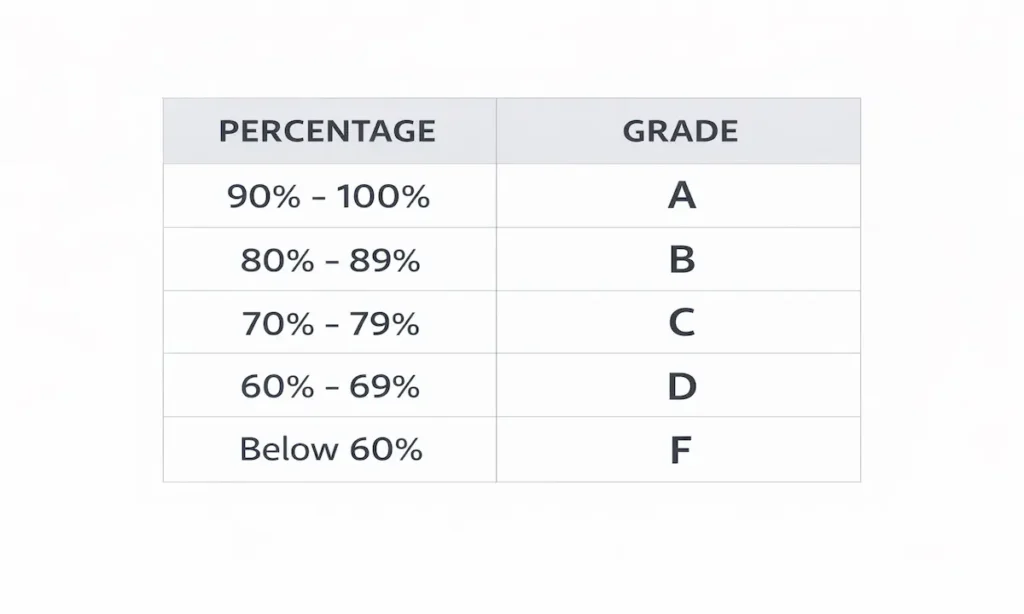
Here is a common conversion table:
| Percentage Range | Letter Grade |
|---|---|
| 90–100% | A |
| 80–89% | B |
| 70–79% | C |
| 60–69% | D |
| Below 60% | F |
Students use this table to check grades.
Parents use it to confirm results.
Teachers use it for basic explanations.
How Does the Plus and Minus Grading System Work?
Some schools use plus and minus grades instead of only A, B, C, D and F.
For example:
- 90–92% may be an A-
- 87–89% may be a B+
- 83–86% may be a B
- 80–82% may be a B-
- 77–79% may be a C+
This system gives a more detailed picture of a student’s score.
However, percentage cutoffs are different from one school to another, so use your school’s grading scale when you need an exact answer.
What Letter Grade Is 80%? Read our complete guide: What Grade Is 80%?
Common Percentage to Letter Grade Conversions
| Percentage | Common Letter Grade |
|---|---|
| 100% | A+ |
| 95% | A |
| 90% | A- |
| 89% | B+ |
| 85% | B |
| 80% | B- |
| 75% | C |
| 70% | C- |
| 65% | D |
| 60% | D- |
| 50% | F |
These are examples based on a common plus/minus scale. Your school may use different grade boundaries.
Step-by-Step Percentage to Letter Grade Example
This example helps students and parents check results.
You scored 76 out of 100.
Step 1:
76 ÷ 100 × 100 = 76%
Step 2:
Check the grading table.
76% falls in the 70–79 range.
Final result:
Your letter grade is C.
Letter Grades and GPA Scale
College students often care more about GPA than letters.
Letter grades often affect GPA calculations, scholarship eligibility, and academic standing. Students can track their academic progress using a GPA calculator.
Here is a common GPA scale:
| Letter Grade | GPA |
|---|---|
| A | 4.0 |
| B | 3.0 |
| C | 2.0 |
| D | 1.0 |
| F | 0.0 |
Some colleges give different GPA points for A+ or A−.
Honors and advanced classes may also change the GPA value.
| Percentage | Letter Grade | GPA |
|---|---|---|
| 90–100% | A | 4.0 |
| 80–89% | B | 3.0 |
| 70–79% | C | 2.0 |
| 60–69% | D | 1.0 |
| Below 60% | F | 0.0 |
If your teacher provides only a percentage score, you can use a grade conversion calculator to determine the corresponding letter grade without manually checking grading tables.
A letter grade can be assigned a GPA value on a 4.0 scale.
A common example is:
| Letter Grade | GPA |
|---|---|
| A | 4.0 |
| A- | 3.7 |
| B+ | 3.3 |
| B | 3.0 |
| B- | 2.7 |
| C+ | 2.3 |
| C | 2.0 |
| C- | 1.7 |
| D | 1.0 |
| F | 0.0 |
The exact GPA value can vary by school. Some institutions also treat A+ differently.
There is no single universal formula for converting a percentage directly to GPA. Many schools first assign a letter grade and then use their own GPA scale.
How Do Letter Grades Convert to GPA?
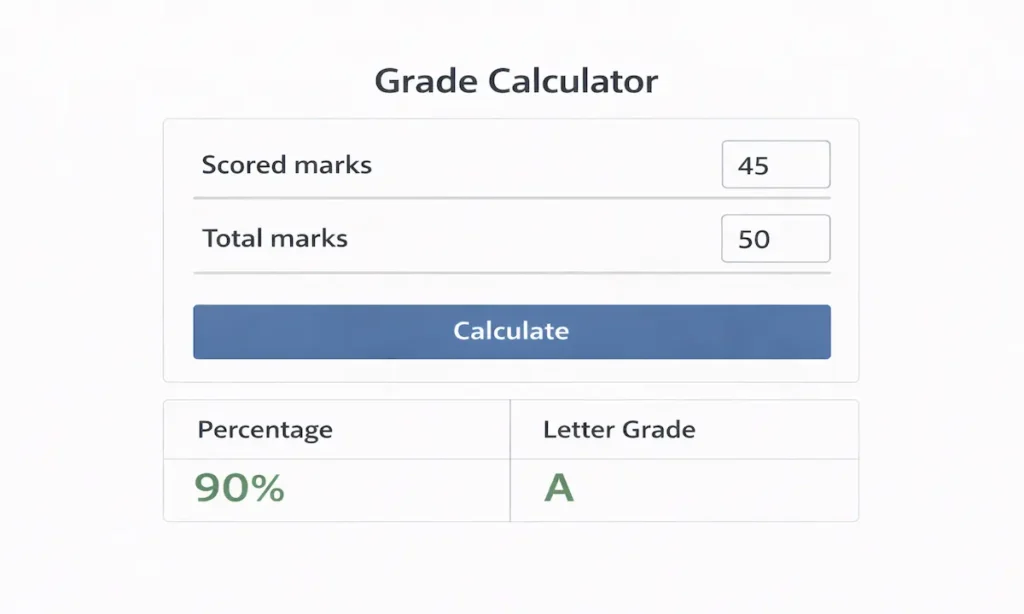
Many users want fast answers.
Before converting your score, make sure your percentage is accurate. An easy grade calculator can help calculate your overall percentage from earned and total points.
Here is how it works:
- Enter your scored marks
- Enter total marks
- The tool finds the percentage
- It matches the percentage to a letter grade
This is useful for:
- Students checking grades
- Parents reviewing results
- Teachers explaining grading
High School vs College Grading
High schools and colleges may use different grading scales.
Many high schools use a simple A–F system, while colleges may use plus and minus grades.
For example, an 80% might be:
- B on a basic grading scale
- B- on a plus/minus scale
Always check the grading scale used by your school or course.
If your course uses weighted assignments, quizzes, and exams, calculate your final percentage first with a weighted average grade calculator before converting it into a letter grade.
Common Mistakes Students Make
These mistakes happen often:
- Averaging percentages instead of total marks
- Using the wrong grading scale
- Assuming all schools use the same rules
Teachers and tutors often warn students about these errors.
Check Your School Grading Policy
Grading rules change by school.
Some schools round percentages.
Some do not.
Some accept a D as passing.
Others need a C or higher.
Parents and students should always check:
- Course syllabus
- School handbook
Do Schools Round Grades?
This is a common student question.
Example:
You score 89.5%.
Some schools round this to 90%.
That may become an A− or A.
Other schools keep it as 89.5%.
That stays a B+.
Always follow your teacher’s grading method.
What Percentage Is a Passing Grade?

Many users want to know if they passed.
In most schools:
- 60% or higher is passing
- Below 60% is failing
A D often means you passed the course.
Still, many college programs require a C or better.
Frequently Asked Questions
What letter grade is 90%?
On a common plus/minus grading scale, 90% is an A-. On a basic grading scale, it may be an A.
What letter grade is 85%?
On a common grading scale, 85% is a B.
What letter grade is 80%?
80% is usually a B on a basic scale and often a B- on a plus/minus scale.
What letter grade is 70%?
70% is usually a C on a basic scale and may be a C- on a plus/minus scale.
Is 60% a passing grade?
It depends on the school and course. Some grading systems treat 60% as passing, while others require a higher score.
How do I convert a percentage to a letter grade?
Find your percentage in the grading scale and match it with the letter grade range. You can also use a percentage-to-letter-grade calculator.
Is there one grading scale used by every school?
No. Schools and colleges can use different percentage ranges and letter-grade cutoffs.
Can I convert a percentage directly to GPA?
There is no single conversion method that works for every school. GPA conversion depends on the grading system used by the institution.
Conclusion
After working with students, parents, and teachers, I have learned that grades feel stressful only when they are unclear. Once you know how percentages turn into letter grades, the confusion fades.
You stop guessing and start trusting the process. This guide gives you that clarity with real examples and simple steps. If you want to double-check your results, our easy grade calculator follows the same method explained here and gives fast, clear answers.

Academic assessment analyst focused on accurate grade calculations, scoring logic, and education-friendly tools at GraderCalculatorPro. His work focuses on helping students, teachers, and educators clearly understand grades, percentages, and academic results through simple and reliable calculation tools.




Leave a Reply