 Skip to content


If you have ever checked your GPA and felt a knot in your stomach, you are not alone. I have spoken with many students who feel stuck between confusion and pressure.
Some worry their GPA is too low to matter. Others have strong grades and still feel unsure. Parents often ask the same quiet question: Is this GPA good enough, or are we missing something?
After reviewing real transcripts and watching how colleges, scholarships, and programs respond, one thing becomes clear very quickly. Most stress surrounding GPA stems from not knowing how it compares to the average GPA or how decision-makers actually interpret it.
This article is here to clear that confusion. It explains what a good GPA really means in high school and college and how to think about GPA in a way that leads to smarter choices, not more worry.
Key Takeaways
- A good GPA depends on your goals, not just the number.
- The average high school GPA in the US is about 3.0.
- A 3.0 GPA keeps many college and scholarship options open.
- Colleges review GPA in context, including course difficulty.
- Improvement over time often matters more than perfection.
What Is GPA?

GPA stands for Grade Point Average. It shows your average performance across all your classes.
Most schools in the US use a 4.0 grading scale:
- A = 4.0
- B = 3.0
- C = 2.0
- D = 1.0
- F = 0.0
Your GPA is calculated by adding your grade points and dividing by the number of classes taken.
This number is used by colleges, scholarship programs, and sometimes employers as a quick academic snapshot.
Weighted vs Unweighted GPA
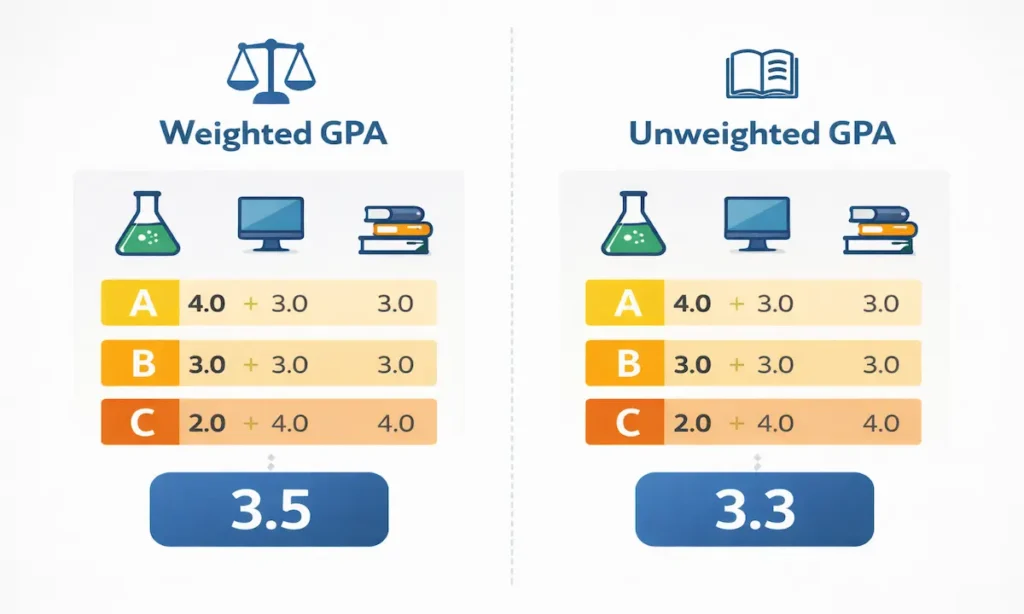
An unweighted GPA treats all classes the same and stays on a 4.0 scale.
A weighted GPA gives extra points for harder classes such as AP, IB, or Honors. This can push GPAs above 4.0.
Example:
- A student earning all A’s in regular classes may have a 4.0 unweighted GPA.
- The same grades in advanced classes could result in a 4.4 or higher weighted GPA.
Colleges usually review both, but an unweighted GPA helps them compare students fairly across schools.
What Is the Average GPA?

Average High School GPA
- The average high school GPA in the US is around 3.0.
This means most students earn a mix of A and B grades.
Average College GPA
- The average college GPA falls between 3.1 and 3.2.
Grading standards vary by school and major, but these numbers reflect national trends.
Average GPA by School Type

Not all schools grade the same way, which is why GPA is always reviewed in context.
- Public high schools: about 3.0
- Private high schools: slightly higher on average
- Community colleges: about 2.8 to 3.0
- Public universities: about 3.0 to 3.2
- Private universities: about 3.2 or higher
This explains why two students with the same GPA may be viewed differently depending on where they studied.
| GPA Range | How It’s Viewed | What It Usually Means |
|---|---|---|
| 3.8–4.0+ | Excellent | Competitive for selective colleges |
| 3.5–3.7 | Very strong | Strong academic standing |
| 3.0–3.4 | Good | Around or above national average |
| 2.5–2.9 | Below average | Options still exist |
| Below 2.5 | Concerning | May need a recovery plan |
What Is a Good GPA in High School?
For high school students, a “good” GPA usually means being at or above the national average.
General guideline:
- 4.0 or higher (weighted): excellent
- 3.5–3.9: very strong
- 3.0–3.4: good and competitive
- 2.5–2.9: below average but workable
- Below 2.5: may limit options
A GPA of 3.0 or higher keeps many college paths open, especially when combined with solid coursework.
What Is a Good GPA in College?
In college, GPA expectations depend more on future plans.
- 3.5 or higher: strong for graduate school and competitive programs
- 3.0–3.4: good standing at most colleges
- 2.5–2.9: acceptable but limits options
- Below 2.5: may trigger academic warnings
Many programs and scholarships set 3.0 as a minimum requirement.
Average GPA by College Major
GPAs vary by field of study.
- Engineering, math, and physical sciences often have lower averages
- Business and economics fall near the middle
- Education, humanities, and arts often report higher averages
Because of this, colleges and employers often compare GPA within a major, not across all students.
| Major Type | Typical GPA Trend |
|---|---|
| Engineering / STEM | Lower average |
| Business / Economics | Middle range |
| Humanities / Education | Higher average |
How Rare Is a 4.0 GPA?
A perfect 4.0 GPA is uncommon, especially in college.
While weighted systems make high GPAs more common in high school, maintaining a perfect GPA in college is difficult due to stricter grading and heavier workloads.
Being close to a 4.0 still places a student among the top performers.
What Is a Good GPA for Different Goals?
State Universities
- Around 3.0 or higher
Highly Selective Colleges
- Often 3.7 or higher, along with challenging coursework
Scholarships
- Many require at least 3.0
- Merit-based awards often expect 3.5 or higher
Graduate School
- Most programs require 3.0 minimum
- Competitive programs prefer 3.5 or higher
Internships and First Jobs
- Many list 3.0 as a baseline
- GPA becomes less important as experience grows
How Colleges Review GPA
Colleges do not rely on GPA alone.
They also consider:
- Course difficulty
- Grade trends over time
- School grading standards
- Class rank, if available
A student who shows improvement and takes challenging classes may be viewed more favorably than one with slightly higher grades in easier courses.
Is GPA Inflation Real?
Yes. Average GPAs have increased over time.
Because of this:
- A “good GPA” today is judged differently than in the past
- Colleges adjust expectations using school profiles
This is another reason GPA is always reviewed in context.
What If Your GPA Is Below Average?
A lower GPA does not end your chances.
Students can:
- Show improvement in later semesters
- Take stronger classes
- Focus on essays, activities, and recommendations
- Begin at a community college and transfer later
Many successful students started with average or below-average GPAs.
GPA and Scholarships
Common GPA thresholds include:
- 2.5: limited options
- 3.0: broad eligibility
- 3.5: strong merit awards
- 3.8 or higher: top academic scholarships
Always check individual scholarship rules.
Does GPA Matter for Jobs?
Sometimes, especially early on.
- Entry-level and competitive fields may ask for a GPA
- Technical and finance roles may use GPA as a filter
- After a few years of experience, GPA matters much less
If your GPA is strong, include it. If not, focus on skills and experience.

What to Do Next
- If your GPA is near average, focus on consistency and steady improvement.
- If your GPA is below average, show progress and balance your application.
- If your GPA is strong, keep challenging yourself without burning out.
Frequently Asked Questions:
Is a 3.0 GPA good?
Yes. A 3.0 GPA is considered average to slightly above average in the United States. It meets the minimum requirements for many colleges, scholarships, and internships.
What GPA is considered good in high school?
A GPA of 3.0 or higher is generally considered good in high school. Competitive colleges often look for GPAs closer to 3.5 or above, especially with challenging courses.
What is the average GPA in college?
The average college GPA in the US is about 3.1 to 3.2. This can vary by school and major, with some programs grading more strictly than others.
Can you get into college with a low GPA?
Yes. Many colleges look at more than GPA, including course difficulty, grade improvement, essays, and activities. Community colleges and transfer pathways are also common options.
Is a 4.0 GPA rare?
Yes. A perfect 4.0 GPA is uncommon, especially in college. While weighted GPAs make high scores more common in high school, maintaining a perfect GPA over time is still difficult.
Conclusion:
From years of working with students and families, I have learned that GPA is a signal, not a sentence. I have seen students with average GPAs succeed because they understood context and focused on progress. I have also seen strong GPAs fall short when students relied on numbers alone.
A good GPA is one that supports your goals and reflects steady effort over time. Once you understand how your GPA compares to the right averages and how it is reviewed, the fear fades, and clarity takes its place. That clarity is what helps students move forward with confidence, no matter where they are starting from.

Academic assessment analyst focused on accurate grade calculations, scoring logic, and education-friendly tools at GraderCalculatorPro. His work focuses on helping students, teachers, and educators clearly understand grades, percentages, and academic results through simple and reliable calculation tools.




Leave a Reply