 Skip to content


A passing grade is the minimum grade needed to successfully complete a class and earn credit. In many U.S. schools, a D or about 60% is considered passing. However, some courses and programs require a C or higher.
The exact passing grade depends on your school, course, program, and grading policy.
Quick Answer
| Score | Common Letter Grade | Usually Passing? |
|---|---|---|
| 90–100% | A | Yes |
| 80–89% | B | Yes |
| 70–79% | C | Yes |
| 60–69% | D | Often |
| Below 60% | F | Usually no |
The most common short answer is: 60% or a D may be passing, but some courses require a C or higher.
Check Your Grade
Enter your scores in grade calculator to calculate your current percentage and letter grade.
Not sure what score you need to pass? Use our Final Grade Calculator to find the score you need on your remaining work.
Quick Takeaways
- Passing grade is usually 60% or a letter D in many schools.
- Major courses often require a C or higher.
- Around a 2.0 GPA is commonly needed to stay in good standing.
- Rules vary by school, program, and course.
- Always check your syllabus or school handbook for exact requirements.
What Does a Passing Grade Mean?
When you pass a class:
- You earn course credit
- You move forward in your program
- The class counts for graduation
- It appears on your transcript
If you fail, you may need to retake the course.
If you are unsure whether your current scores are enough to pass, an easy grade calculator can help you calculate your percentage and see where you stand before final grades are released.
Passing Grade Scale in the United States
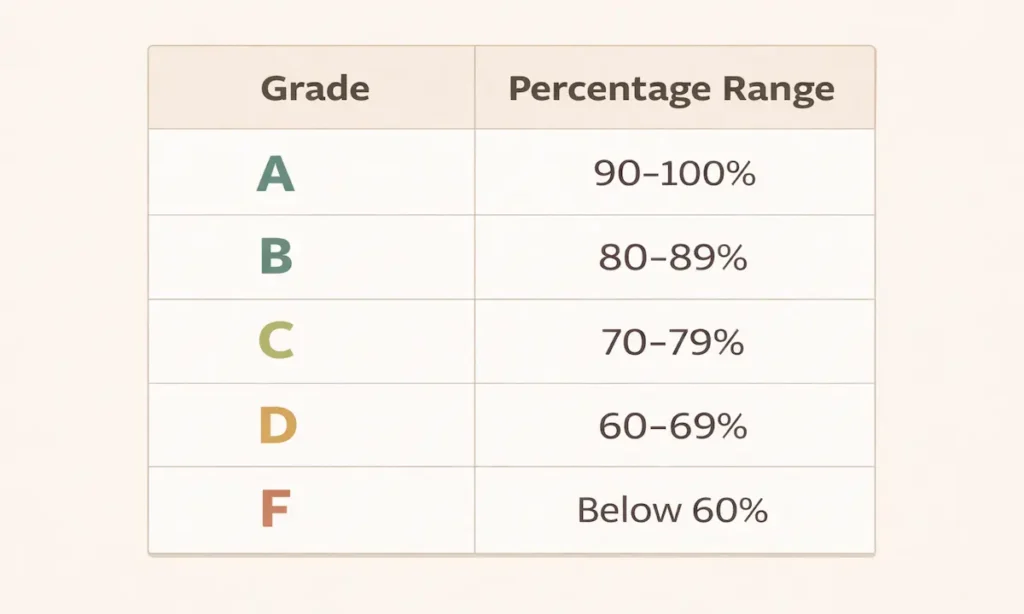
| Letter | Percentage | Meaning |
|---|---|---|
| A | 90–100 | Excellent |
| B | 80–89 | Good |
| C | 70–79 | Average |
| D | 60–69 | Lowest passing in many schools |
| F | Below 60 | Fail |
Some schools adjust the scale slightly.
Is 60% a Passing Grade?
In many U.S. grading systems, 60% is the lowest passing percentage and usually represents a D.
However, 60% is not automatically passing everywhere. Some schools, courses, and programs require 65%, 70%, or a C or higher.
| Situation | Is 60% Usually Enough? |
|---|---|
| General class | Often yes |
| Major course | May require a C |
| Prerequisite | Often requires a C |
| Transfer course | May require a C |
| Graduate course | Usually not |
If you need an exact answer, check your syllabus, school handbook, or program requirements.
Is 70% a Passing Grade?
Yes, 70% is generally a passing grade on common U.S. grading scales.
It is usually a C, although a school using plus and minus grades may classify 70–72% as a C-.
A 70% is usually enough to pass a general course, but some programs require a higher grade for major or prerequisite courses.
For a detailed breakdown, see What Grade Is 70%?
What Is a Passing Grade in High School?
High school students often ask if a D is enough. In many schools, it is, and you earn credit.
Still, higher grades help with college entry and scholarships. Some districts require a C in key subjects like math or English.
If you are close to failing, speak with a teacher early.
What Is a Passing Grade in College?
College students often worry about how grades affect their degree.
- A D may pass some general classes
- A C or higher is often required for major courses
- Some programs do not accept D grades
If you plan to transfer, many schools accept only a C or better.
Minimum Passing Grade by Course Type
Electives:
Often allow a D.
Major courses:
Usually requires at least a C.
Prerequisite classes:
Often requires a C to continue.
Graduate classes:
Usually requires a B.
Is a D Always a Passing Grade?

Is a C a Passing Grade?
Yes. A C is normally a passing grade.
A C is often enough to earn course credit, and it may meet requirements where a D is not accepted.
Some competitive programs require an even higher grade, so always check the requirements for your specific course or program.
What Should You Do Based on Your Grade?
| Situation | What It Means | What To Do |
|---|---|---|
| Got a D in an elective | Likely passed | Move forward |
| Got a D in a major class | May not count | Check program rules |
| GPA below 2.0 | Risk of warning | Talk to advisor |
| Failed class | No credit earned | Plan retake |
| Close to failing | Need quick action | Seek help early |
No. A D may pass the class but may not count for your major, transfer, or graduation requirements. It can also lower your GPA.
What Percentage Is Considered Passing?
Most schools set a passing around 60 percent. Some use higher marks like 65 or 70 percent, or a satisfactory rating in pass or fail courses.
Because grading scales vary between schools and countries, many students use a grade conversion calculator to compare percentage grades, letter grades, and GPA equivalents.
Passing GPA Requirements
Schools look at your overall GPA.
- A 2.0 GPA is often needed to stay in good standing
- A lower GPA may lead to warnings
- Some programs require higher
Keeping your GPA steady helps avoid academic warnings and scholarship issues. You can track your academic performance with our GPA Calculator and use a grade conversion calculator to compare different grading systems.
Academic Probation Explained
If your GPA falls too low, you may be placed on academic probation.
During this time:
- You must improve grades within a set period
- Advisors may monitor progress
- Course limits may apply
Passing classes helps you stay in good standing.
What International Students Should Know
International students must keep full enrollment and pass classes.
Low grades may affect:
- Enrollment status
- Visa conditions
Advisors can help if problems arise.
How Parents Can Understand Passing Grades
Parents often review report cards and wonder what grades mean.
Look for:
- Letter grades and percentages
- GPA trends
- Teacher comments
If grades fall, speak with school staff early.
What Happens If You Barely Pass?
If you pass with a low grade:
- You earn credit
- GPA may drop
- Future classes may feel harder
You may choose to retake for a stronger result.
When You May Need to Retake a Class
You may retake if:
- You earned an F
- Your program requires a higher grade
- You want to improve your GPA
- You need a stronger understanding
Pass or Fail Grading Explained
Some classes use pass or fail.
If you pass:
- You earn credit
- GPA impact may be limited
Why Passing Rules Differ by School
Each school sets its own policies based on standards and program needs. That is why passing marks can vary.
Tips If You Are Close to Failing

- Speak with your teacher or professor early
- Ask for tutoring
- Review missed work
- Make a study plan
- Attend extra help sessions
Real Life Examples
Example 1: 62% in an elective
A student earns 62%. If the school treats 60% as passing, the student passes the course and earns credit.
Example 2: 62% in a major course
The student may technically pass, but the program may require a C or higher. The course may need to be repeated.
Example 3: 75% in a college course
A 75% is usually a C or C-range grade and is generally passing. It may satisfy most course requirements, but the program rules still apply.
Example 4: 58% in a class
If the passing mark is 60%, 58% is below the passing level and would normally be an F.
Why Passing Grades Matter
Passing helps you:
- Graduate on time
- Meet requirements
- Keep aid
- Stay eligible for activities
- Build a strong record
Key Points
- A passing grade means you earn credit.
- Many schools treat 60 percent or a D as passing.
- Major and graduate courses often require higher grades.
- Policies differ by school.
- Strong grades create more options.
Common Mistakes Students Make
- Assuming a D counts for every course.
- Ignoring GPA requirements until it is too late.
- Waiting too long to ask for help.
- Not checking transfer or program rules.
Frequently Asked Questions
What is the minimum passing grade in the U.S.?
In many U.S. schools, 60% or a D is the lowest passing grade. However, some schools, courses, and programs require a higher grade.
Is 60% a passing grade?
Often, yes. A 60% is commonly treated as a D and may be passing, but some courses require a C or higher.
Is 70% a passing grade?
Yes. A 70% is generally passing and is usually around a C or C- depending on the grading scale.
Is a D a passing grade?
A D may be passing, but it may not satisfy a major, prerequisite, transfer, or graduation requirement.
Is a C a passing grade?
Yes. A C is normally a passing grade and often satisfies more course requirements than a D.
Is 50% a passing grade?
Usually not on a grading scale where 60% is the minimum passing score. However, grading rules vary by school.
Can you pass a class with a D?
Yes, if your school counts a D as passing. Some programs require a C or higher even when a D gives you course credit.
What is a passing grade in college?
It depends on the course and program. A D may pass some classes, while major and prerequisite courses often require a C or higher.
What is a passing grade in high school?
Many high schools consider 60% or a D to be passing, but local school policies can differ.
Does a passing grade count toward your degree?
Not always. A passing grade may give you course credit but still fail to meet the grade requirement for a major, prerequisite, or transfer course.
Conclusion
From years of examining grading policies and helping students interpret academic rules, it is clear that understanding passing grades early helps avoid many problems later. A passing mark means progress, but knowing the details helps you protect your GPA, stay eligible for programs, and plan with confidence.
Always review your school guidelines and ask questions if anything feels unclear, because informed decisions today can make your academic path smoother and less stressful.

Academic assessment analyst focused on accurate grade calculations, scoring logic, and education-friendly tools at GraderCalculatorPro. His work focuses on helping students, teachers, and educators clearly understand grades, percentages, and academic results through simple and reliable calculation tools.




Leave a Reply