



Many students feel confused when their grades do not match their effort. Homework scores look good, quizzes go well, yet the final grade feels lower than expected.
This confusion often comes from weighted grades, where some assignments count more than others, even if that is not clear at first.
I have been in that situation myself. I remember checking my grades before a final exam and realizing the test carried more weight than everything else combined.
I had to sit down, read the syllabus, and do the math carefully to know where I stood. That experience showed me how important it is to understand weighted grades early, not at the last minute.
- Weighted grades give more importance to major work like exams
- Each grade must be multiplied by its weight
- Final exams can change your grade more than homework
- A grade calculator helps avoid math mistakes
- Planning early reduces stress before finals
What Is a Weighted Grade?

A weighted grade means some assignments count more than others.
For example:
- Homework may count 30%
- Quizzes may count 20%
- Exams may count 50%
Because exams matter more, they affect your final grade the most.
What Is a Weighted Average Grade?
A weighted average grade is your final score after weights are applied.
Each grade is multiplied by its weight.
All results are then added together.
This method shows your true performance.
How to Calculate Weighted Grades
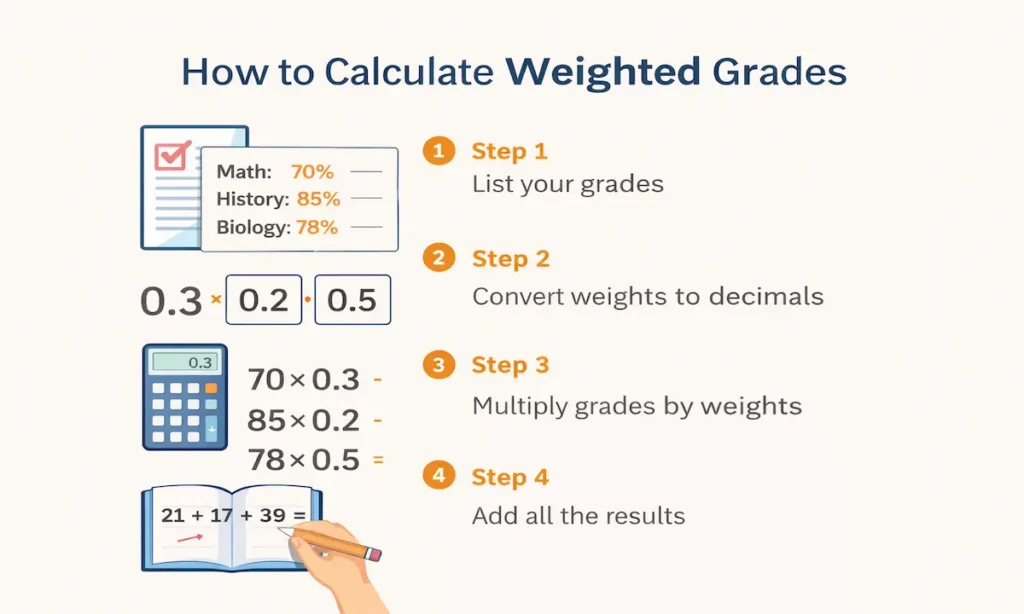
To calculate weighted grades, follow these steps:
- List each grade
- List each weight
- Multiply grades by weights
- Add the results
This gives your final weighted grade.
The Weighted Grade Formula
Use this formula:
Weighted Grade = Σ (Grade × Weight)
If weights are percentages, convert them into decimals.
Examples:
- 40% → 0.40
- 25% → 0.25
| Percentage | Decimal |
|---|---|
| 10% | 0.10 |
| 20% | 0.20 |
| 30% | 0.30 |
| 40% | 0.40 |
| 50% | 0.50 |
Example of a Weighted Grade Calculation
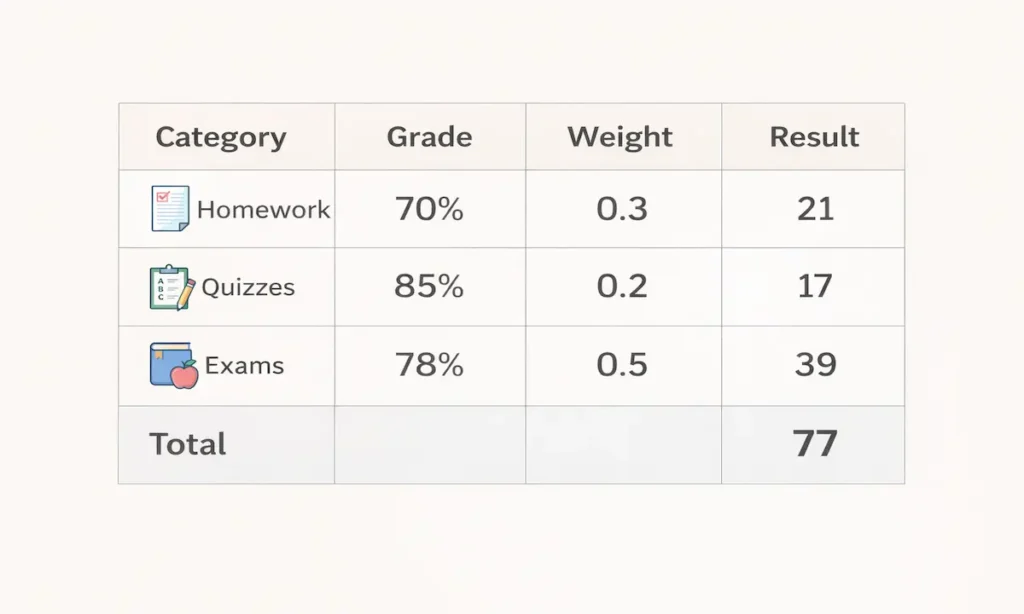
| Category | Grade | Weight |
|---|---|---|
| Homework | 90 | 30% |
| Quizzes | 80 | 20% |
| Exams | 70 | 50% |
Convert weights:
- 30% = 0.30
- 20% = 0.20
- 50% = 0.50
Multiply:
- 90 × 0.30 = 27
- 80 × 0.20 = 16
- 70 × 0.50 = 35
Add totals:
27 + 16 + 35 = 78
Final weighted grade = 78%
How to Calculate Grade as a Weighted Average
Sometimes weights do not add up to 100.
This happens in some classes.
In this case:
- Multiply grades by weights
- Add weighted scores
- Add all weights
- Divide the total score by the total weight
This gives the correct weighted average grade.
What Grade Do I Need on the Final Exam?
Many students ask this before exams.
To calculate this, you need:
- Your current grade
- Final exam weight
- Target final grade
Example
Current grade: 82%
Final exam weight: 30%
Target grade: 90%
82 × 0.70 = 57.4
90 − 57.4 = 32.6
32.6 ÷ 0.30 = 108.7
You would need about 109%.
This means the target grade is not possible.
This method helps students plan early.
How Extra Credit Affects Weighted Grades
Extra credit can help your grade.
It may:
- Raise a category average
- Add bonus points
Example
Homework weight: 30%
Average before extra credit: 85%
After extra credit: 90%
85 × 0.30 = 25.5
90 × 0.30 = 27
Extra credit added 1.5 points to the final grade.
How Dropped Scores Work in Weighted Grades
Some teachers drop the lowest score.
This often applies to quizzes or homework.
Example
Scores:
- 60
- 80
- 90
Lowest score dropped: 60
New average:
(80 + 90) ÷ 2 = 85
This average is then weighted.
Category Weighting vs Points-Based Grading
These systems work differently.
| Feature | Category Weighting | Points-Based Grading |
|---|---|---|
| Uses percentages | Yes | No |
| Groups assignments | Yes | No |
| Final exam impact | High | Depends on points |
| Easy to plan finals | Yes | Sometimes |
| Common in schools | Very common | Common |
Category Weighting
- Grades grouped by type
- Each group has a percent
- Example: Tests 50%, Homework 30%
Points-Based Grading
- All assignments earn points
- Final grade = points earned ÷ points possible
The same scores may give different results.
Students and parents should always check the syllabus.
How to Calculate Weighted Grades in Excel or Google Sheets
Spreadsheets help students, parents, and teachers track grades.
Formula Example
Grades in B2:B5
Weights in C2:C5
=SUMPRODUCT(B2:B5,C2:C5)/SUM(C2:C5)This formula works even if the weights do not equal 100.
Using a Grade Calculator
A Grade Calculator saves time.
It helps you:
- Check grades fast
- Test score changes
- Plan for finals
This is useful before exams.
Common Mistakes to Avoid
- Forgetting to convert percentages
- Adding grades without weights
- Using wrong category values
- Mixing points with percentages
These mistakes often cause confusion.
- Check your syllabus
- Confirm all category weights
- Convert percentages into decimals
- Drop lowest scores if allowed
- Include extra credit if given
Frequently Asked Questions:
How do you calculate weighted grades?
You calculate weighted grades by multiplying each grade by its weight. Then you add all the weighted results together. The final number is your weighted grade.
What is the formula for weighted average grade?
The weighted average grade uses grade multiplied by weight. All weighted values are added together. If needed, divide by the total weight.
How do I calculate my grade with different weights?
Start by listing each grade and its weight. Multiply each grade by the correct weight. Add the results to get the final grade.
What grade do I need on my final exam to pass?
Use your current grade, the final exam weight, and your goal grade. Subtract your current score from the target. Divide by the final exam weight to find the score you need.
Are weighted grades better than simple averages?
Yes, because exams and projects usually count more.
Weighted grades reflect this difference.
Simple averages treat all work the same.
Conclusion
Weighted grades can seem confusing, but they do not have to be. I have used these same steps to check grades, plan for finals, and explain results clearly to others. Once you know how weights work and how to calculate them, you stop guessing and start making better decisions. This method is simple, reliable, and used in real classrooms every day.

Academic assessment analyst focused on accurate grade calculations, scoring logic, and education-friendly tools at GraderCalculatorPro. His work focuses on helping students, teachers, and educators clearly understand grades, percentages, and academic results through simple and reliable calculation tools.





Leave a Reply