



Grades can feel frustrating.
Many students work hard all semester, then feel confused or upset when the final grade is lower than expected. I have seen students ask why homework scores did not help more, and parents ask how one exam changed everything. This confusion usually comes from one thing. The grading system was never clear.
I have helped students review grades and plan finals, and this issue comes up again and again. The problem is not effort. The problem is how grades are weighted. A weighted average grade gives more value to certain types of work, such as exams.
Once students understand this, grades stop feeling random and start making sense. That is what this guide explains.
Key Takeaways
- A weighted average grade gives more importance to major work like exams
- All weights must add up to 100 percent
- Final exams often have the biggest impact on grades
- Knowing your grade weights helps you plan better
- Weighted grading explains why one test can change a full grade
Weighted Grade Calculation

In weighted grading, each type of work has a weight.
A weight is a percentage.
Here is a common setup used in many schools:
- Homework: 20%
- Quizzes: 30%
- Final exam: 50%
The higher the weight, the more it affects the final grade.
This is why one exam can change a full course grade.
Weight Total Rule in Weighted Grading
All weights must add up to 100%.
If decimals are used, they must add up to 1.0.
Example:
- Homework: 20%
- Quizzes: 30%
- Final exam: 50%
20 + 30 + 50 = 100
If the total is wrong, the final grade will also be wrong.
This mistake happens often.
What Is a Weighted Average Formula
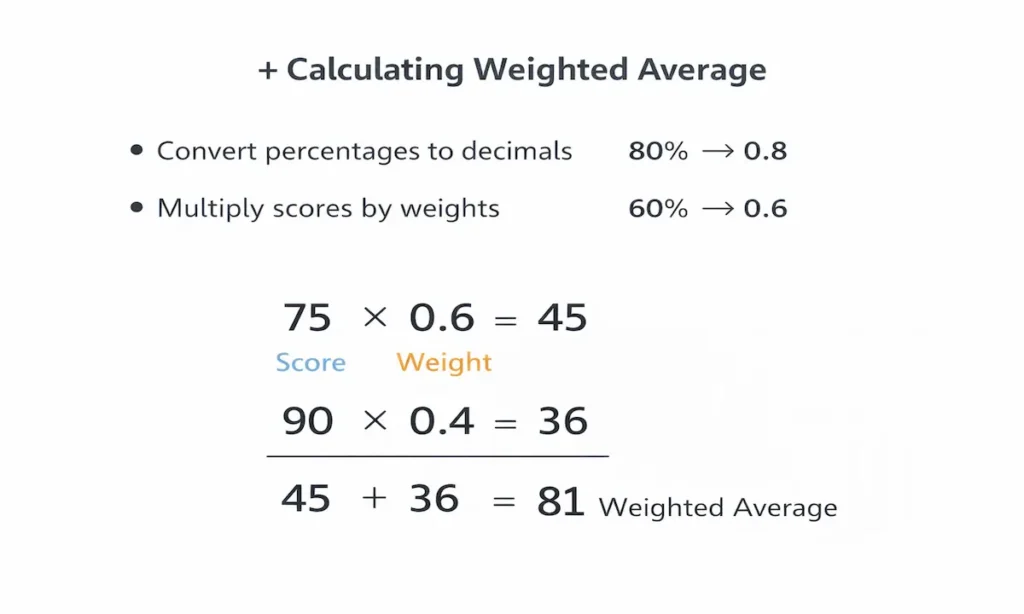
The formula is simple.
Each score is multiplied by its weight.
Then all results are added.
Formula:
Score × Weight = Weighted score
Add all weighted scores to get the final grade.
Percentages must be changed into decimals.
- 20% = 0.20
- 30% = 0.30
- 50% = 0.50
Example of a Weighted Average Grade
Here is a real example.
- Homework: 90 × 0.20 = 18
- Quizzes: 80 × 0.30 = 24
- Final exam: 70 × 0.50 = 35
Add the results:
18 + 24 + 35 = 77
The final weighted average grade is 77%.
The final exam has the biggest effect because it has the highest weight.
Simple Weighted Grade Table Example
This table shows the same example in a clear way.

| Category | Weight | Score |
|---|---|---|
| Homework | 20% | 90 |
| Quizzes | 30% | 80 |
| Final Exam | 50% | 70 |
Each score is multiplied by its weight.
All results are added to find the final grade.
Category-Based Grading System
Many schools use category-based grading.
Each type of work is grouped into a category.
Each category has its own weight.
Common categories include:
- Homework
- Quizzes
- Tests
- Projects
- Final exam
This system is widely used in online grade books.
It is another form of weighted grading.
Final Exam Impact on Grades
Final exams usually have the highest weight.
This means they can raise or lower grades quickly.
A strong final exam can improve a course grade.
A weak one can undo earlier work.
That is why students often ask what score they need on the final.
Final Grade Calculator and Why It Helps

A final grade calculator helps plan scores.
Students use calculators to answer questions like:
- What score do I need on the final to pass?
- Can I still earn a B or A?
Calculators are helpful.
Knowing the method helps check results.
What Score Do I Need on the Final?
| Current Grade | Final Exam Weight | Score Needed on Final |
|---|---|---|
| 85% | 40% | 78% |
| 88% | 50% | 82% |
| 90% | 60% | 85% |
This shows how final exam weight changes the score needed.
Related GPA Calculator
Weighted grading is often tied to GPA.
Some schools use weighted GPA systems.
Advanced classes may earn higher grade points.
This can raise the overall GPA.
That is why GPA calculators are often used with weighted grading.
What Is the Difference Between Weighted and Unweighted GPA?
An unweighted GPA treats all classes the same.
An A always has the same value.
Class difficulty does not matter.
A weighted GPA gives extra value to harder classes.
This can raise the final GPA score.
Both systems are common in the USA.
Weighted vs Unweighted Grading
| Feature | Weighted Grading | Unweighted Grading |
|---|---|---|
| Class difficulty matters | Yes | No |
| Exam impact | Higher | Same as other work |
| GPA scale | Can go higher | Fixed scale |
How Is an Unweighted GPA Calculated?
Each letter grade has a fixed value.
- A = 4
- B = 3
- C = 2
All class values are averaged.
No class receives extra credit for difficulty.
What Is a Weighted GPA?
A weighted GPA adds extra points for advanced classes.
For example, an A in an advanced class may be worth more.
This helps show academic effort.
Many high schools and colleges use this system.
Why Your Weighted GPA Matters
Colleges often review weighted GPA.
It shows both performance and class difficulty.
A strong weighted GPA can support applications.
Each school reviews grades in its own way.
When to Use a Weighted Average
A weighted average is used when some work matters more.
Schools use it because:
- Exams test full knowledge
- Homework builds practice
- Projects show long-term effort
This creates a fair grading balance.
Who Uses Weighted Grading
Weighted grading is used at many levels.
- Middle schools use it to balance skills
- High schools use it for GPA accuracy
- Colleges use it for course results
The goal stays the same.
Important work has more effect.
Common Mistakes in Weighted Grading

Small errors can change grades.
Common mistakes include:
- Weights do not add up to 100%
- Percentages are not changed into decimals
- A category is counted twice
Checking these avoids grade errors.
Frequently Asked Question
Does a weighted average grade increase your final grade?
A weighted average grade can increase your final grade if you score well on high-weight work like exams. If exam scores are low, the final grade can drop even if homework scores are high.
Why do exams count more than homework in weighted grading?
Exams cover more material and test overall learning. Schools give them more weight because they show how well students understand the full course.
What happens if the grading weights do not add up to 100 percent?
If the weights do not equal 100 percent, the final grade will be wrong. The weights must be fixed before calculating the weighted average grade.
Is weighted grading used in college classes?
Yes. Many college classes use weighted grading. Professors usually list the weights for exams, homework, and projects in the course syllabus.
How can I calculate the score I need on my final exam?
You need your current grade, the final exam weight, and your target grade. You can use a final grade calculator or apply the weighted average formula to find the needed score.
Conclusion
After helping students and parents work through grading systems, one lesson stands out. Grades feel fair only when people know how they are calculated. A weighted average grade is used to show what matters most in a class, not to surprise students at the end.
I have seen students improve results just by learning how weights work. They focused on high-value work and planned better for exams. Once you understand weighted grading, you gain control. You know where to put your effort, and there are no last-minute shocks. That clarity makes a real difference.

Academic assessment analyst focused on accurate grade calculations, scoring logic, and education-friendly tools at GraderCalculatorPro. His work focuses on helping students, teachers, and educators clearly understand grades, percentages, and academic results through simple and reliable calculation tools.





Leave a Reply