 Skip to content

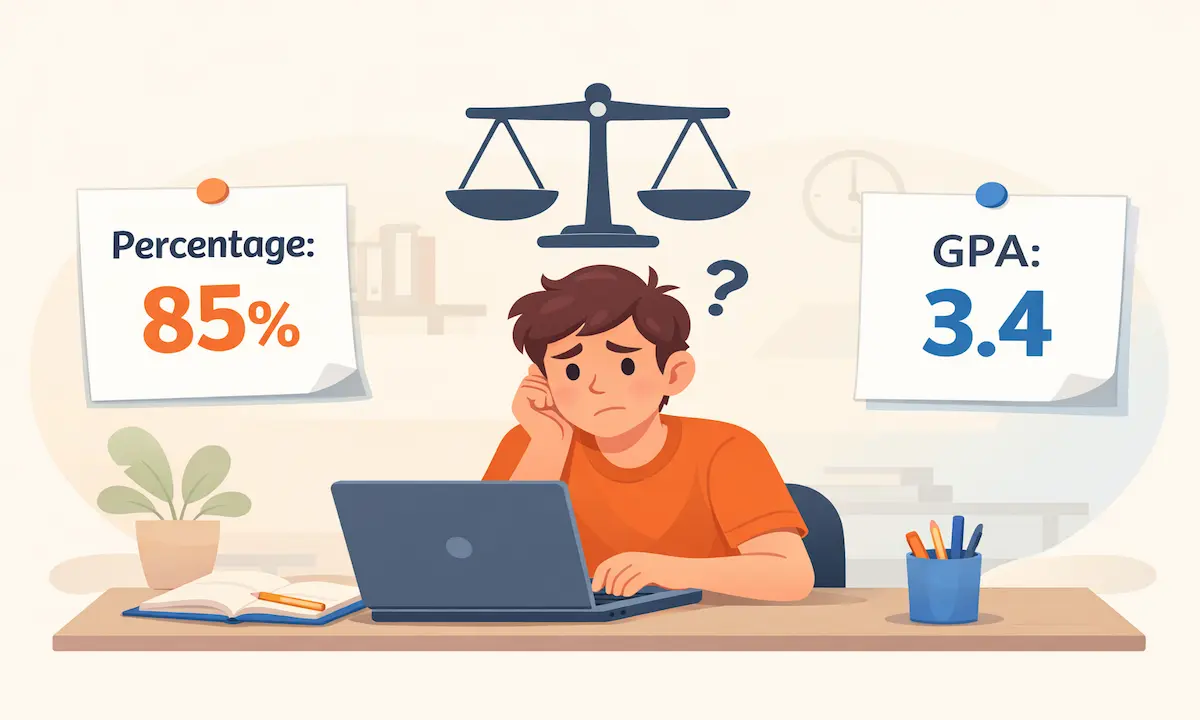
Many students feel confused when they start filling out college applications. The form asks for GPA, but their marks are in percentages. They open a calculator, search online, and see different answers everywhere. Some students worry they will convert it incorrectly. Others are not sure if they should convert it at all. This small question creates a lot of stress.
I have seen this problem many times while guiding students through applications. International students often fear that one wrong conversion could hurt their chances. US high school students feel unsure about weighted and unweighted GPAs.
Parents also struggle to understand which number matters more. That is why learning the real difference between GPA vs percentage is important before trying to convert percentage to GPA.
GPA vs Percentage
A percentage shows marks out of 100.
A GPA shows grades on a fixed scale, usually 4.0 in the United States.
Key difference:
- The percentage shows raw marks
- GPA shows grade averages
Many countries use percentages.
US schools mostly use GPA.
This difference matters during applications.
What Is Percentage?
The percentage shows how many marks you scored out of 100.
Example:
If you score 85 out of 100, your percentage is 85%.
Many schools outside the US use this system.
It is easy to read but harder to compare across countries.
What Is GPA?
GPA means Grade Point Average.
Grades are changed into numbers.
Those numbers are averaged.
Most US schools use a 4.0 scale.
Basic idea:
- A = high GPA
- B = medium GPA
- C = lower GPA
GPA helps schools compare students from different backgrounds.
GPA Scale Used in the US
A common US GPA scale looks like this:
- A = 4.0
- B = 3.0
- C = 2.0
- D = 1.0
- F = 0.0
Some schools use plus and minus grades.
In most colleges, A+ still equals 4.0.
Unweighted GPA Scale
Unweighted GPA has a top value of 4.0.
All classes count the same.
Example:
- English A = 4.0
- Math A = 4.0
Class difficulty does not matter here.
Weighted GPA Scale
Weighted GPA adds extra points.
Harder classes carry more weight.
Examples:
- Honors classes
- AP classes
Weighted GPA can go above 4.0.
This system is common in US high schools.
Note on High School GPA vs College GPA
This point is important.
Weighted GPA is mainly used in high school.
It rewards advanced courses.
College GPA is usually unweighted.
It stays on a 4.0 scale.
This difference affects how grades are reviewed.
Percentages to Letter Grades to GPA
Many schools follow this pattern:
| Percentage | Letter Grade | GPA |
|---|---|---|
| 90–100 | A | 4.0 |
| 80–89 | B | 3.0 |
| 70–79 | C | 2.0 |
| 60–69 | D | 1.0 |
| Below 60 | F | 0.0 |
This table is common.
But each school may adjust the ranges.
How to Convert Percentage to GPA

This is the most used method online.
Simple Formula
GPA = (Percentage ÷ 100) × 4
Example
If your percentage is 85%:
85 ÷ 100 = 0.85
0.85 × 4 = 3.4 GPA
This result is an estimate.
It helps for general comparison only.
Another GPA Calculation Example
Here are more examples:
- 75% → about 3.0 GPA
- 90% → about 3.6 to 4.0 GPA
- 65% → about 2.6 GPA
Values change by school policy.
How to Convert GPA to Percentage
Some students need the reverse calculation.
Formula
Percentage = (GPA ÷ 4) × 100
Example
If GPA is 3.2:
3.2 ÷ 4 = 0.8
0.8 × 100 = 80%
Why GPA vs Percentage Matters for US Colleges

US colleges mainly review GPA.
If your transcript shows a percentage only, conversion helps with comparison.
Some colleges:
- Convert grades themselves
- Ask for both GPA and percentage
International students should read the instructions carefully.
Short Note on CGPA
Some education systems use CGPA.
CGPA averages grade points across subjects.
The idea is close to GPA.
The method to convert a percentage to CGPA is similar.
Rules differ by institution.
Variation Across Schools
There is no single standard.
One school may say:
- 90% = A
Another may say:
- 93% = A
This changes GPA outcomes.
That is why online conversions are estimates.
Common Mistakes Students Make
Many students face issues here:
- Using one formula for all colleges
- Mixing weighted and unweighted GPA
- Converting grades when schools say not to
Always check official admission guidelines.
GPA Calculator Tools
Online GPA calculators can help.
Useful calculators offer:
- 4.0 scale
- Weighted options
- Multiple subjects
They support planning, not final submission.
Key Takeaway
- The percentage shows marks out of 100
- GPA shows grade averages on a fixed scale
- US colleges mostly use GPA
- Conversion is not exact
- Some colleges convert grades themselves
If you keep these points in mind, the process feels much easier.
When You Should NOT Convert Your Grades
Do not convert your grades if:
- The college asks for original transcripts only
- The application form calculates GPA automatically
- The college requires a credential evaluation service
In these cases, converting grades on your own can cause errors.
Quick Percentage to GPA Reference Chart
This chart gives a general idea only.
Actual results can change by school.
| Percentage Range | Approximate GPA |
|---|---|
| 90% and above | 3.7 – 4.0 |
| 80% – 89% | 3.0 – 3.5 |
| 70% – 79% | 2.0 – 3.0 |
| 60% – 69% | 1.0 – 2.0 |
| Below 60% | Below 1.0 |
Use this for planning, not for final submission.
Safe Approach to Follow
If you feel unsure, submit grades exactly as they appear on your transcript.
Let the college handle the conversion.
This avoids mistakes and keeps your application accurate.
Frequently Asked Questions:
1. What is the main difference between GPA and percentage?
The main difference is the scale. The percentage shows marks out of 100. GPA shows grade averages, usually on a 4.0 scale. A percentage is common outside the US.GPA is common in US schools and colleges.
2. How do I convert a percentage to GPA?
A common method is:
GPA = (Percentage ÷ 100) × 4
For example, 80% becomes about a 3.2 GPA. This is only an estimate. Schools may use their own method.
3. Is a percentage better than GPA?
No system is better. The percentage shows exact marks. GPA helps schools compare students easily. US colleges usually prefer GPA for applications.
4. What percentage is equal to a 4.0 GPA?
In many schools, 90% or higher equals a 4.0 GPA. Some schools require 93% or higher. There is no single rule. Always check the school’s grading policy.
5. Should I convert my percentage to GPA for US college applications?
Only convert grades if the college asks you to. Some US colleges prefer original transcripts. Others convert grades themselves. Always follow the instructions given by the college.
Final Thoughts
From real experience working with students and reviewing applications, one thing is clear. There is no perfect universal formula. Percentage and GPA are simply different grading systems. Colleges use them to understand academic performance, not to confuse applicants.
When you convert a percentage to GPA, treat the result as a guide unless a college clearly asks you to report it. Always follow official instructions and submit grades in the format required. Once you understand GPA vs percentage, the process becomes simpler, and the stress fades.

Academic assessment analyst focused on accurate grade calculations, scoring logic, and education-friendly tools at GraderCalculatorPro. His work focuses on helping students, teachers, and educators clearly understand grades, percentages, and academic results through simple and reliable calculation tools.




Leave a Reply