


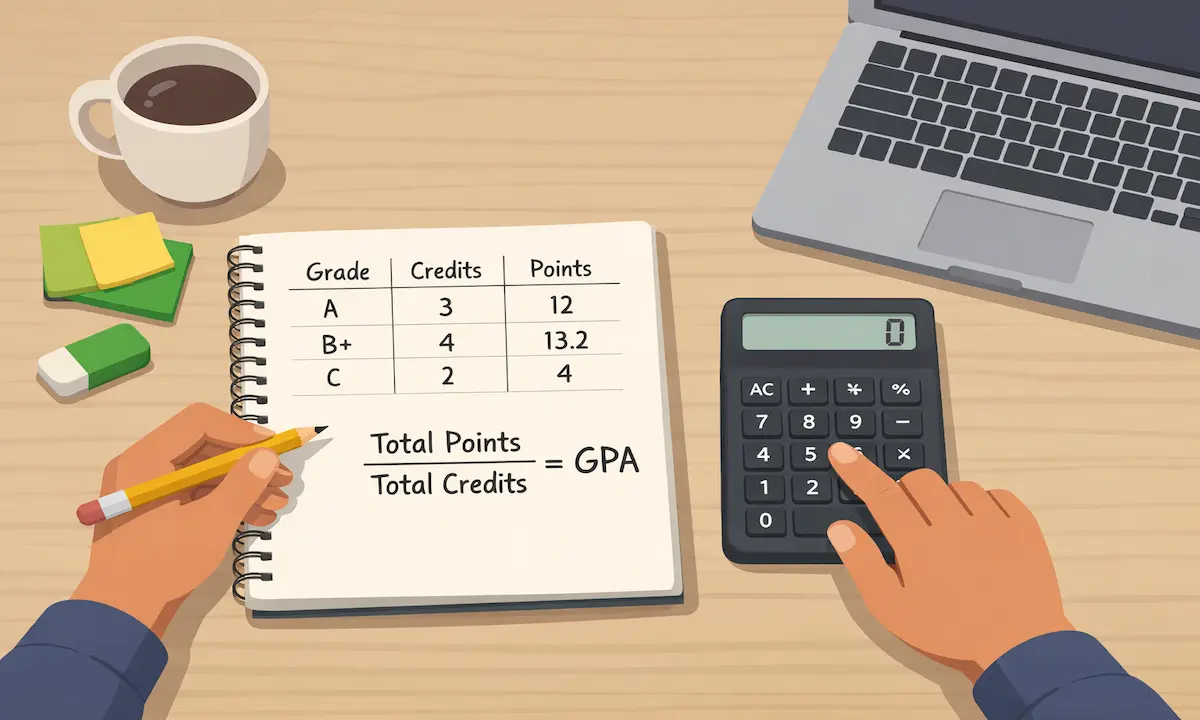
Many students feel stuck when they try to calculate their GPA. They look at grades, credits, and numbers, but the result still feels confusing. Some worry they will make a mistake. Others feel pressure because college or scholarships depend on this one number.
I have seen this problem again and again while helping students and parents. Most people are not bad at math. They just never clearly learned the steps. Once the process is explained simply, GPA stops feeling stressful and starts making sense.
This guide explains how to calculate GPA in a clear way.
You will also learn the GPA calculation formula with examples that work for high school, college, and transfer students.
- Convert letter grades to grade points
- Multiply grade points by credit hours
- Add total grade points
- Divide by total credit hours
What Is GPA?
GPA is a number that shows your average grade.
Each class gives a letter grade.
Each letter grade has a point value.
Those points are used to calculate GPA.
Most schools in the USA use a 4.0 scale.
Why Is GPA Important?
GPA helps schools compare students.
It is used to:
- Review college applications
- Decide scholarships
- Check academic progress
For parents, GPA shows how a student is doing.
For students, GPA affects future options.
The GPA Calculation Formula
This is the basic formula used by most schools.
GPA Calculation Formula:
Total grade points ÷ total credit hours = GPA
This formula works for both high school and college.
GPA = Total Grade Points ÷ Total Credit Hours
Letter Grade to GPA Conversion
Each letter grade equals a number.
| Letter Grade | Grade Points |
|---|---|
| A | 4.0 |
| A- | 3.7 |
| B+ | 3.3 |
| B | 3.0 |
| B- | 2.7 |
| C+ | 2.3 |
| C | 2.0 |
| D | 1.0 |
| F | 0.0 |
Some schools treat A+ as 4.0.
Others may treat it as 4.3.
Always follow your school’s grading rules.
- High school students
- College students
- Transfer students
- Parents and counselors
How to Calculate GPA Step by Step

These steps work for students, parents, and counselors.
Step 1: List all classes
Write down every course.
Step 2: Write credit hours
Each class has credits.
Step 3: Convert grades to points
Use the table above.
Step 4: Multiply points by credits
This gives grade points for each class.
Step 5: Add total grade points
Add all class totals.
Step 6: Divide by total credits
This gives your GPA.
GPA Calculation Example
This example fits most students.
| Class | Grade | Points | Credits | Total |
|---|---|---|---|---|
| Math | A | 4.0 | 3 | 12.0 |
| English | B | 3.0 | 3 | 9.0 |
| Science | A- | 3.7 | 4 | 14.8 |
Total grade points = 35.8
Total credits = 10
GPA = 35.8 ÷ 10 = 3.58
How to Calculate GPA With Credit Hours
Credit hours change GPA results.
A class with more credits affects GPA more.
This matters most for college students.
Always multiply:
Grade points × credit hours
Semester GPA vs Cumulative GPA
Semester GPA
Shows GPA for one term.
Cumulative GPA
Shows GPA for all terms combined.
Parents and counselors often look at cumulative GPA.
Colleges usually review cumulative GPA.
Weighted GPA and Unweighted GPA

Some high schools use weighted GPA.
Unweighted GPA
- Uses a 4.0 scale
- All classes count the same
Weighted GPA
- Honors, AP, or IB classes get extra points
- Example: A may count as 5.0
Weighted GPA helps show harder coursework.
How to Calculate GPA With Plus and Minus Grades
Plus and minus grades change GPA slightly.
Example:
- B+ = 3.3
- B = 3.0
- B- = 2.7
Always follow your school scale.
Common GPA Scales Used in US Schools
Different schools use different scales.
| GPA Scale | Common Use |
|---|---|
| 4.0 scale | Most colleges and many high schools |
| 4.3 scale | Some colleges |
| 5.0 scale | Many high schools with honors or AP |
Check the transcript to confirm the scale.
Another GPA Calculation Example
This example helps students plan ahead.
| Class | Grade | Points | Credits | Total |
|---|---|---|---|---|
| History | B+ | 3.3 | 3 | 9.9 |
| Biology | A | 4.0 | 4 | 16.0 |
| Art | B | 3.0 | 2 | 6.0 |
Total grade points = 31.9
Total credits = 9
GPA = 31.9 ÷ 9 = 3.54
This shows how credit size matters.
How to Round GPA Correctly
Most schools round GPA to two decimals.
Example:
- 3.567 becomes 3.57
Some schools do not round.
Follow official rules.
How Repeated Courses Affect GPA
This matters for transfer students.
Schools may:
- Replace the old grade
- Average both grades
- Count both attempts
Colleges often recalculate GPA later.
How Colleges Recalculate GPA
Colleges may change GPA during review.
They may:
- Remove weighted points
- Exclude some classes
- Focus on core subjects
This is common in admissions.
How to Convert Percentage to GPA (4.0 Scale)
Some schools use percentages.
Example ranges:
- 90–100% = 4.0
- 80–89% = 3.0
- 70–79% = 2.0
Rules differ by school.
Common GPA Calculation Mistakes
Students often:
- Forget credit hours
- Use the wrong scale
- Mix weighted and unweighted values
- Round too early
Parents and counselors should double-check these.
| Mistake | What Happens |
|---|---|
| Forgetting credit hours | GPA looks incorrect |
| Using the wrong GPA scale | GPA is too high or too low |
| Rounding too early | Final GPA changes |
| Mixing weighted and unweighted grades | Results become inaccurate |
- Check your transcript carefully
- Confirm your school’s GPA scale
- Calculate GPA step by step
- Save the result for applications
Conclusion
After working with students, parents, and counselors, one thing is clear. GPA feels hard only until you see how it works.
The formula stays the same, and the steps never change. When you understand them, you can check your grades with confidence and plan your next move without guessing.
Now you know how to calculate GPA and how schools use it, and that knowledge gives you control.

Academic assessment analyst focused on accurate grade calculations, scoring logic, and education-friendly tools at GraderCalculatorPro. His work focuses on helping students, teachers, and educators clearly understand grades, percentages, and academic results through simple and reliable calculation tools.





Leave a Reply